Does Kit Carson Go Into the Militery Again Does Kit Carson Go Into the Military Again
By Mike Phifer
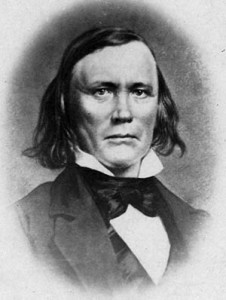
The 2 Indian scouts ignored the gawking soldiers as they rode into where the bluecoated troops had bivouacked for the night at Mule Springs in the Texas Panhandle on November 24, 1864. They headed direct for Colonel Christopher Houston "Kit" Carson, commander of the trek, to study what they had institute. Ten miles to the e the scouts had cut the trail of a big grouping of Indians driving cattle and horses. Nearby Carson had 400 men, including New United mexican states and California volunteer infantry and cavalry and Ute and Jicarilla Apache scouts. He also had two mountain howitzers, 27 supply wagons, and an ambulance. His mission was to defeat the hostile Comanche and Kiowa.
With discussion that hostile Indians were in the vicinity, Carson ordered his cavalrymen to mountain up. Leaving the infantry to baby-sit the wagons at Mule Springs and then follow in the morning, Carson's force moved out only before dark. The men were on strict orders non to talk or smoke. By midnight they had found the fresh trail of the band of Indians they were pursuing. Carson ordered a halt, preferring to look for daylight before pushing any farther into hostile country.
This article was first published in the July 2016 edition of
Military Heritage
Social club your subscription here!
When the start streaks of dawn finally appeared in the eastern sky, Kit Carson and his men rode out again. The Ute and Jicarilla scouts rapidly discovered three enemy pickets. Afterwards discarding their buffalo robes, the scouts galloped afterwards the fleeing pickets. Carson ordered most of his cavalry afterwards the scouts, knowing that a Comanche or Kiowa village could not be far away.
Carson followed forth with a small detachment of cavalry acting as escorts for the slower moving howitzers. Just ahead the cavalry and scouts attacked a Kiowa hamlet of 200 lodges. The Kiowa warriors retreated downriver followed by Carson's men. Unbeknownst to the bluecoats, the Kiowa women and children, along with a white captive woman and two children, were hiding in the foothills nearby.
When Carson caught up with the bulk of his men they were at Adobe Walls, a trading post that had been established in the mid-1840s but was now abandoned. The cavalrymen had corralled their mounts in the stout ruins of Adobe Walls and then spread out as skirmishers. About 200 Comanche and Kiowa were galloping back and forth in front of the skirmishers. They shouted at the bluecoats and fired at them from underneath the necks of their horses. More than than 1,000 Comanche and Kiowa warriors were spotted moving forward.
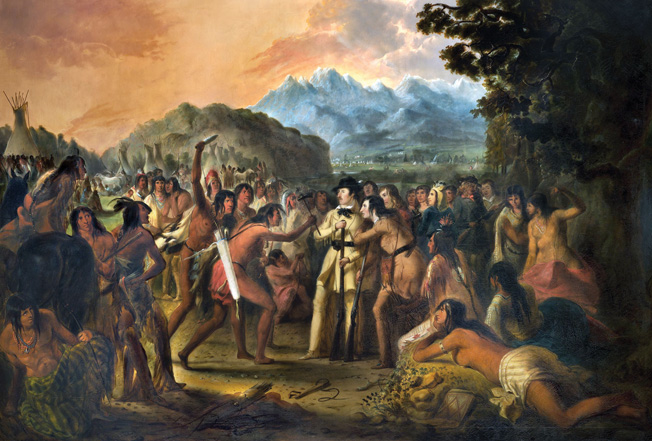
a trapper exploring the American West and gaining valuable noesis of the land and the native peoples.
On Carson's orders the howitzers fired on the Indians, sending them on a dead run for a Comanche hamlet of 500 lodges that lay a mile away. Carson, believing the fight was over, ordered his men to eat something and h2o their horses before pushing on to destroy the Comanche hamlet.
In less than half an hr the Comanche and Kiowa had returned. They were adamant to fight. Kit Carson and his men were in for the fight of their lives. Fortunately, they had a seasoned frontiersman leading them. If anybody could become them out of their predicament, information technology was Carson.
Kit's Beginnings
Born on Dec 24, 1809, in Richmond, Kentucky, Kit Carson was raised in Missouri, where his family moved in 1811. Carson, who received his nickname from his family, grew up under the threat of Indian raids and did not get much schooling. He was unable to read or write but was skilful at learning languages. In add-on to his native English language, he likewise spoke Spanish and a number of Indian languages.
After his father died and his mother remarried, Carson became increasingly rebellious. At 16, Carson's mother apprenticed him to a saddle maker in Franklin, Missouri. Carson stuck it out for two years and so abruptly left his apprenticeship in Baronial 1826. He landed a job working in a caravan headed for Santa Fe.
In the post-obit years, Carson worked every bit a trapper exploring much of the American W gaining valuable knowledge of the land and the natives, having lived with them and fought with and against them. In 1842, Carson'southward life was to change when he met Lieutenant John Charles Fremont of the Corps of Topographical Engineers. Carson joined Fremont, the "Great Pathfinder," as a guide in three of his Western expeditions. In Carson'southward last expedition with Fremont, they crossed the Sierra Nevada Mountains during the winter to arrive in California, then part of Mexico. Carson, by Fremont's side, served with stardom in California during the Mexican State of war.
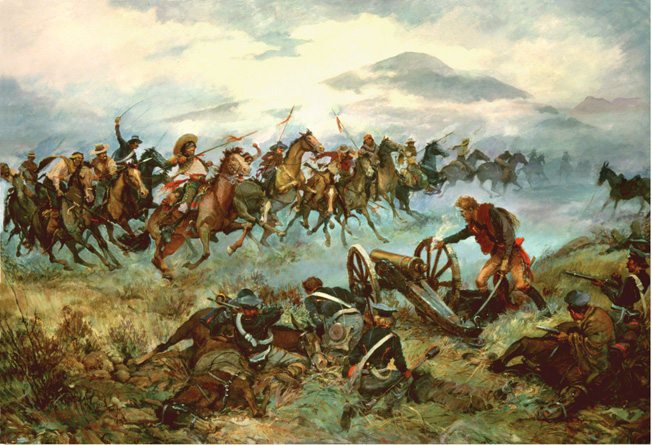
Fremont, brevetted with the rank of major, fabricated Carson a lieutenant during the war. On September five, 1846, Carson rode out of Los Angeles with a small grouping of men intending to carry a dispatch beyond the continent to Washington. A month later near Socorro, New Mexico, they ran into Brig. Gen. Stephen Kearny'south Army of the W, which had been sent to capture New Mexico and California. Much to his chagrin, Carson was ordered to give the acceleration to another scout and guide the ground forces dorsum to California. Assertive California was under American control, Kearny took only 121 dragoons and ii mount howitzers, sending the rest of his men back to Santa Fe.
Upon reaching California, Kearny was soon to larn that it was in rebellion over again. Joined by a small force of men, Kearny pushed on toward San Diego. Before he reached it, though, Kearny's men before long found themselves engaged with enemy lancers at San Pasqual on December 6. Carson was dismounted during the fight and well-nigh got trampled, but he survived unscathed, which could non exist said for Kearny and many of his men. The battered troops slowly pushed on the side by side mean solar day while being harassed past the enemy. Thirty miles from San Diego, Kearny's men entrenched on a loma and sent three men forrard for help. Kit Carson was one of three men who slipped out in the darkness. All three men made it to San Diego, and reinforcements were ordered out to assistance Kearny.
Carson carried dispatches to Washington in 1847, where he met with President James Polk. The president deputed Carson a second lieutenant in the Regiment of Mounted Riflemen and ordered him to carry dispatches dorsum across the continent. Carson'due south early armed forces career would be brief considering the Senate refused to confirm the appointment.
A National Hero
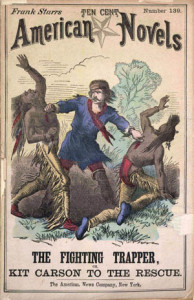
The soft-spoken, diminutive frontiersman was soon to get a national hero when Fremont wrote glowingly of him in his widely published reports of his expeditions. It would not be long before so-called claret and thunder novels were being penned about Kit Carson's hair-raising, bloodthirsty fictional exploits.
After his first brief military service, Carson returned to his home and his young wife to take upwards farming and ranching in New Mexico. In early 1854, Carson was appointed equally Indian Agent for the Ute tribe. He would hold this position for seven years until the start of the American Civil War. On May 24, 1861, Carson resigned his position and a month later was commissioned a lieutenant colonel, becoming second in command in the 1st Regiment of New Mexico Volunteers. When its aged commander, Colonel Ceran St. Vrain, resigned, Carson took charge of the outfit and was promoted to full colonel in October.
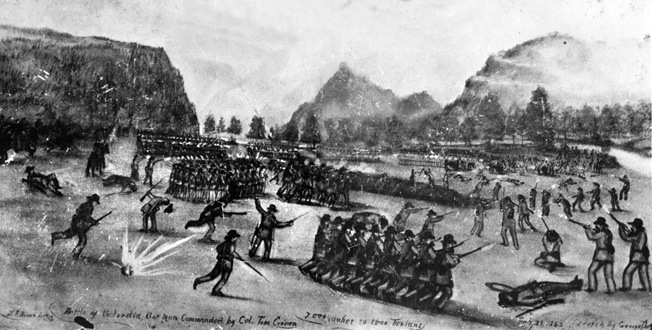
During the Amalgamated invasion of New Mexico, Kit Carson led his men into activeness at the Battle of Valverde on Feb 21, 1862, along the Rio Grande. Although inexperienced, Carson's New Mexicans proved capable soldiers. At Carson's proffer his troops were posted on the w side of the Rio Grande, allowing his men to watch the battle raging on the east side to steady themselves. Carson and his New Mexicans presently entered the bloody fray when they were ordered to cantankerous the river and join in on an assault on the Confederates. The Rebels launched a two-pronged counterattack. Carson proved to exist a steady leader pacing upwards and downward the line calling out to his men, "Firme, muchachos, firme!" Carson's New Mexicans beat back the Confederates attacking them and considered the battle won. They were shocked and surprised when they heard the bugle telephone call to retreat. The Rebel attack on the Matrimony left had done much meliorate, capturing some Federal guns and driving off the troops defending them. Post-obit orders, Carson and his men forded the Rio Grande and retreated with the rest of the Union forces.
The Confederate advance into New Mexico was stopped at Glorieta Pass in tardily March 1862, and the Rebels were before long retreating to Texas. The Federal troops in the territory and so turned their attention to dealing with raiding Mescalero Apaches, Navajos, Comanches, and Kiowas, in which Kit Carson was to play a pivotal role. By this fourth dimension Carson commanded the 1st New United mexican states Volunteer Cavalry Carson was ordered by Brig. Gen. James Carleton, commander of the Section of New Mexico, in late September to reopen Fort Stanton, which had been abandoned during the Confederate invasion. Fort Stanton was to serve as a base from which Carson could pursue the Mescalero Apaches. "There is to exist no council with the Indians nor any talks," said Carleton. "The men are to exist slain whenever and wherever they can be found. The women and children may be taken as prisoners, only, of course, they are not to be killed." Carleton informed Carson that if the Indians begged for peace, then their chief and 20 of their principal men were to get to Santa Fe, while Carson was to continue to hunt downward Apaches.
Carson did non like the guild, thinking it too harsh as he had been friends at one time with the Mescalero Apaches. Carson argued for more humane treatment of them, knowing that they were poorly armed and had been driven to areas where there was little game. Carleton would have none of it. He wanted them hunted downward and killed. Carson followed his orders and led his men after the Mescaleros.
Information technology was a quick war with Carson leading his men from Fort Stanton, while two other detachments of troops moved against the Mescalero Apaches from Mesilla and Franklin. Past the end of the year, Carson was looking after a large number of starving natives at Fort Stanton.
Scorched World
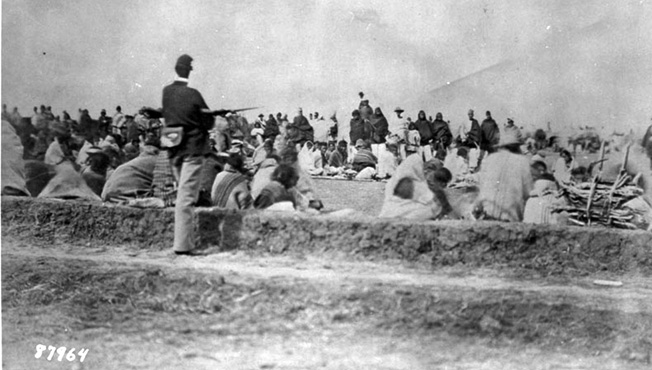
Later, Kit Carleton turned his attending to the Navajos. Carleton had made peace offers to the Navajos that required them to get to the reservation at Bosque Redondo in eastern New Mexico to acquire to back up themselves by farming. He gave them until July 20, 1863, to become in or they would be considered hostile. Not surprisingly, they rejected the offer. Carson would soon observe himself back in the saddle campaigning against the Navajos; still, he was not great on warring with them. By that time, Carson was in poor health. He had tried to resign from the army every bit early on as Feb 1863, only Carleton had refused his resignation.
It was a brutal scorched-earth campaign that continued into the winter of 1863-1864. Carson would take his men correct into Canyon de Chelly, the stronghold of the Navajo. On Jan 9, 1864, Carson led his men to the western finish of a ruby-red rock, steep-cliffed canyon, while Captain Albert Pfeiffer with two companies of troops pushed through from the eastern end of the canyon. Three days later Pfieffer joined up with Carson, having met minimal resistance and captured 19 starving women and children. The next day 60 starving Navajos surrendered to Carson. Thousands more would follow. Past mid-March, 6,000 Navajos had surrendered with the number somewhen increasing to 8,000. In the Navajos 400-mile long walk to Bosque Redondo, many would dice from starvation, disease, and exposure.
A Battle of Desperation
Afterward a short stint in command at Fort Sumner overseeing the Bosque Redondo reservation, Kit Carson again attempted to resign. Carleton again rejected the offer, instead sending him to chastise the Comanches and Kiowas who had been causing havoc on the Santa Atomic number 26 Trail during the summer of 1864, attacking emigrant trains and ground forces caravans. The attacks were so bad that the regular army'southward supply line and mail were nearly cut. Carleton ordered Carson to punish the Indians earlier the onset of winter. Setting out on November 12, Carson would a petty over 2 weeks later detect himself in a desperate situation at Adobe Walls.
The Comanche and Kiowa warriors returned to Adobe Walls, existence careful not to bunch up and offering themselves every bit targets to Carson's two howitzers. Instead, many of them dismounted and, using the tall grass every bit cover, skirmished with the bluecoats, while the bulk of them charged across the troopers' front firing from nether the necks of their horses. Carson urged his men to stay at-home and straight their burn down at the waves of warriors attacking them.
It was shortly becoming painfully clear that Carson and his men had bitten off more than they could handle. They estimated the warriors they were now facing numbered about 3,000. Parties of warriors were spotted a couple of miles away, heading for the Kiowa village the bluecoats had earlier passed to get horses and see to the safety of their women and children.
Carson now began to fear for the safety of his supply wagons and 75 foot soldiers left to escort them. At iii:30 pm, he ordered the horses to exist brought out in preparation for a retreat despite the protests of many of his officers who wanted to push on to the large Comanche village. With years of feel in Indian warfare under his belt, Carson knew it was time to get his men out.
While i trooper in four led the horses, the other bluecoats spread out equally skirmishers on the flanks to protect the retreating column. The crews of the two howitzers, meanwhile, brought up the rear, blasting away at the pressing warriors who increased their attacks.
"Indians charged so repeatedly and with such desperation that for some time I had serious doubts for the safety of my rear," wrote Carson. To brand matters worse, the Comanches and Kiowas lit a grass fire that swept toward the retreating column. Using the smoke as cover, some warriors got close to the column and fired into it before being discovered. To avoid the fire, Carson and his men had to climb the bluffs of the river valley. At that place they could better see the situation that faced them
Past sundown Kit Carson and his men had reached the Kiowa hamlet, which they found total of Indians attempting to save their possessions. Later the mountain howitzers fired a couple of shells into the village, the troopers charged. They plundered the lodges of buffalo robes and fifty-fifty plant some white women's clothing. They then ready burn to 160 lodges and some equipment the Indians had captured before. The two guns, which were repositioned on a xx-human foot hill, continued to blindside abroad. Each time they were fired, the recoil sent them down the hill, where they would accept to be manhandled support again. I terminal parting shot from the gun into a group of thirty or 40 retreating warriors from the southern part of the village concluded the battle.
The Sentinel Resigns
By nightfall Carson and his command, exhausted from 30 hours of fighting, reached their supply wagons and escort, which were still safe. Despite the ferocity of the boxing, Carson's casualties were remarkably low-cal, with ii troopers and an Indian scout killed and equally 25 wounded. Three of these would succumb to their wounds. Casualties could have been much worse, and an officer serving with Carson believed the 2 mountain howitzers had kept the command from being wiped out. But Carson'due south coolness and sound judgment also played a meaning role in their survival. The Comanches and Kiowas, Carson estimated, suffered sixty killed and wounded, although their losses may have been considerably greater.
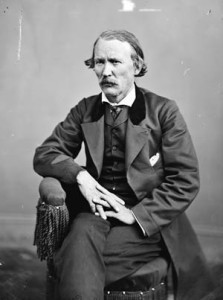
Carleton chosen Kit Carson's battle at Adobe Walls "a vivid victory." Carson admitted iv years later that the Indians had defeated him. But Carson'southward foray showed the Comanches and Kiowas that they were not safety from attack even deep in their own territory. Carson was brevetted a brigadier full general in March 1866, simply his wellness chop-chop deteriorated. He resigned from the U.Southward. Ground forces the following twelvemonth. The legendary soldier and scout died at the age of 58 on May 23, 1868, in Fort Lyon, Colorado.
Source: https://warfarehistorynetwork.com/2016/06/15/the-legendary-kit-carson-scout-and-soldier/
0 Response to "Does Kit Carson Go Into the Militery Again Does Kit Carson Go Into the Military Again"
Postar um comentário